Ayahuasca Vine (Banisteriopsis caapi)
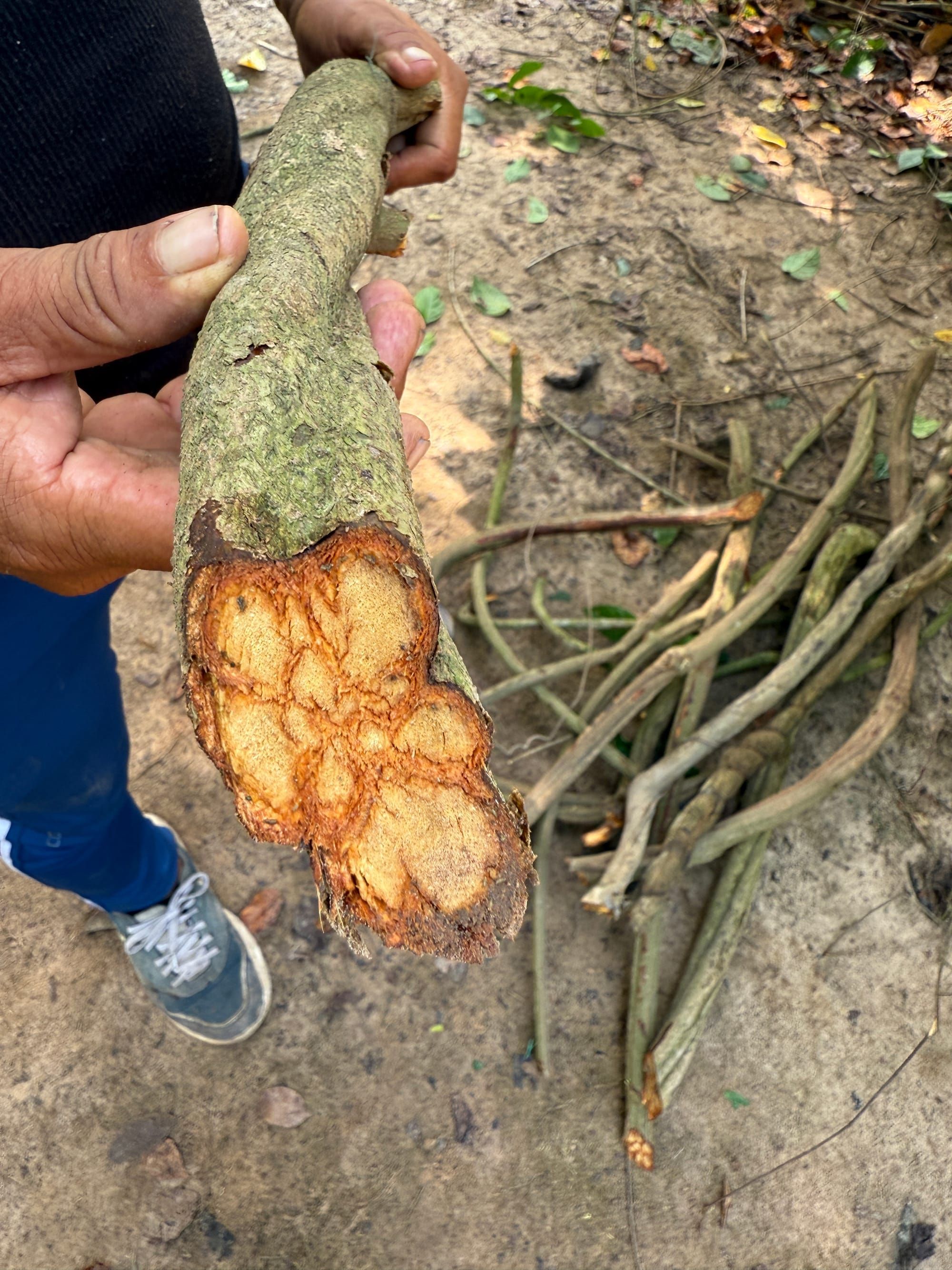
Cross-section of Banisteriopsis caapi vine, showing the characteristic star pattern
At a Glance
Banisteriopsis caapi is the giant Amazonian liana at the heart of ayahuasca — and in many traditions the name "ayahuasca" belongs to the vine itself, not the brew. It contains the β-carboline alkaloids harmine, harmaline and THH, which reversibly inhibit the enzyme MAO-A; this is what lets the DMT in admixture plants such as chacruna become orally active. On its own the vine is sedative and introspective rather than strongly visionary — traditions call it the "spirit" or "strength" of the medicine, the true teacher, while the leaf brings the "light." It is revered as a master plant and dieted as one of the most important teacher plants of the western Amazon.
| Detail | Information |
|---|---|
| What it is | The Amazonian vine (liana) that is the basis of the ayahuasca brew |
| Scientific name | Banisteriopsis caapi (Spruce ex Griseb.) C.V. Morton (Malpighiaceae) |
| Also called | Ayahuasca, yagé; Oni (Shipibo); "vine of the soul" |
| Key compounds | β-carbolines: harmine, harmaline, tetrahydroharmine (THH) |
| How it works | Reversible MAO-A inhibition → makes admixture DMT orally active |
| The vine alone | Sedative, introspective, mildly psychoactive — not strongly visionary, and contains no DMT |
| Classification | Master plant; dieted as mayor (greater) |
| Key risk | MAO-A inhibition → serotonin-syndrome risk with SSRIs/SNRIs and other drugs (see Safety) |
Introduction
Banisteriopsis caapi is a giant woody liana native to the Amazon rainforest and one of the most significant Amazonian plants culturally and pharmacologically in South America. "Ayahuasca" refers both to the vine and to the psychoactive decoction in which it is the primary ingredient (Schultes & Hofmann, 1992; McKenna, 2004). Indigenous communities have used the vine for centuries as a sacred medicine, particularly the Shipibo-Konibo of Peru (Brabec de Mori, 2011). Its pharmacological significance derives from beta-carboline alkaloids—harmine, harmaline, and tetrahydroharmine (THH)—which act as reversible MAO-A inhibitors (Callaway, 2005; McKenna et al., 1984), enabling the oral bioavailability of DMT from admixture plants such as Psychotria viridis (McKenna et al., 1984). Scientific interest now spans phytochemistry, safety, and therapeutic potential for depression, addiction, and neurodegeneration (Hamill et al., 2019; Palhano-Fontes et al., 2019; dos Santos et al., 2016).
Taxonomy and Nomenclature
Banisteriopsis caapi belongs to the family Malpighiaceae. Its accepted classification (GBIF; Plants of the World Online [POWO], Kew):
- Kingdom: Plantae
- Phylum: Tracheophyta
- Class: Magnoliopsida
- Order: Malpighiales
- Family: Malpighiaceae
- Genus: Banisteriopsis
- Species: Banisteriopsis caapi (Spruce ex Griseb.) C.V. Morton
The species was initially described as Banisteria caapi by Richard Spruce and formally published by August Grisebach, then transferred to Banisteriopsis by C.V. Morton in 1931 (POWO). The genus honours John Banister, a 17th-century English clergyman and naturalist (Schultes & Hofmann, 1992). Common synonyms include Banisteria caapi Spruce ex Griseb., Banisteriopsis inebrians C.V. Morton, and Banisteriopsis quitensis (Nied.) C.V. Morton (GBIF; POWO).
Common names vary by region and language. In Quechua, aya ("soul/spirit") + waskha ("vine/rope") yields "vine of the soul." The Shipibo-Konibo name is Oni. Spanish speakers use Ayahuasca or Yagé (Schultes & Hofmann, 1992; Brabec de Mori, 2011).
Botanical Description and Habitat
B. caapi is a perennial woody liana reaching up to 30 m by twining around canopy trees. The stem has smooth, chocolate-brown bark with characteristic knots giving a rope-like appearance (Schultes & Hofmann, 1992; NTBG [grey/informal source]). Leaves are simple, opposite, evergreen, oval, 8–18 cm long and 3.5–8 cm wide. Flowers are small (12–14 mm diameter), pale pink or white, blooming infrequently—typically in January (NTBG [grey/informal source]). The fruit is a winged samara characteristic of Malpighiaceae.
Infrequent flowering and low seed set mean B. caapi propagates primarily through stem cuttings, a method used by indigenous cultivators to maintain specific valued cultivars (Schultes & Hofmann, 1992). Its native range spans the lowland tropical rainforest of Brazil, Colombia, Peru, Ecuador, Bolivia, and Venezuela (GBIF; POWO), typically along riverbanks and in clearings.
Active Compounds and Pharmacological Mechanisms
Beta-Carboline Alkaloids
The three principal alkaloids are harmine, harmaline, and 1,2,3,4-tetrahydroharmine (THH) (McKenna et al., 1984; Callaway, 2005; Gambelunghe et al., 2008).
Alkaloid concentrations in dry stem tissue vary substantially with cultivar, plant age, plant part, and analytical method. McKenna et al. (1984) reported the following ranges across six cultivated stem samples: harmine 0.057–0.64% (mean 0.39%), harmaline 0.005–0.38% (mean 0.19%), and THH 0.025–0.33% (mean 0.15%) of dry stem weight. Total beta-carboline content in stems has been reported at 0.11–0.83% of dry weight, with harmine constituting 40–96% of total beta-carbolines (McKenna et al., 1984). Broader surveys report total alkaloid content ranging from approximately 0.05% to 1.95% of dry weight, with roots generally containing higher concentrations than stems (Rivier & Lindgren, 1972; Wang et al., 2010). Concentrations in prepared decoctions vary further depending on preparation method and source material (Callaway, 2005).
Note: Some secondary sources report harmine ranges as high as 8.43%, but these figures likely conflate measurements across different plant parts, preparation types, or analytical contexts. The peer-reviewed literature on dry stem tissue consistently reports harmine below 1% of dry weight (McKenna et al., 1984; Rivier & Lindgren, 1972).
MAO-A Inhibition
Harmine and harmaline are reversible, selective inhibitors of MAO-A (Herraiz et al., 2010; Kim et al., 1997). Harmine exhibits approximately 10,000-fold selectivity for MAO-A over MAO-B, with a Ki in the low-nanomolar range (~5 nM) for MAO-A (Kim et al., 1997). Harmaline likewise acts primarily on MAO-A with negligible MAO-B inhibition at pharmacologically relevant concentrations (Herraiz et al., 2010). This MAO-A inhibition prevents gut and hepatic degradation of orally ingested DMT, enabling its absorption and central activity (McKenna et al., 1984).
Note on MAO-B: Some in vitro studies have reported MAO-B inhibitory activity for harmine and harmaline at higher concentrations (Herraiz et al., 2010). However, at the concentrations achieved through oral consumption of B. caapi, the pharmacologically dominant action is MAO-A inhibition. Claims that these alkaloids are "potent MAO-B inhibitors" overstate the evidence; their relevance to MAO-B inhibition in vivo remains to be established in human studies.
Additional Mechanisms
THH is a weaker MAO-A inhibitor than harmine but also acts as a weak serotonin reuptake inhibitor (SRI), increasing synaptic serotonin concentrations (Frecska et al., 2016). In vitro studies have demonstrated that harmine and THH can stimulate adult neurogenesis by promoting proliferation of human neural progenitor cells (Morales-García et al., 2017). B. caapi extracts also exhibit antioxidant properties (via polyphenols including proanthocyanidins, epicatechin, and procyanidin B2) and anti-inflammatory effects on microglial cells (Werneck Lopes Santos et al., 2022; Wang et al., 2010).
Psychotropic Properties and Documented Effects
Consumed alone, B. caapi produces sedative, introspective, and mildly psychoactive effects—emotional clarity and gentle body-awareness—without the intense visual hallucinations characteristic of DMT (Luna, 1986). Practitioners describe the vine as providing the "spirit" or "strength" of the experience, with the admixture plant providing the "light" or visions.
The full brew typically produces effects within 30–60 minutes, peaking at ~2 hours and lasting 4–6 hours (Riba et al., 2003). Reported effects include intense visual imagery, auditory alterations, introspection, memory retrieval, and emotional release (Shanon, 2002; Riba et al., 2003). The purgative effect (la purga)—nausea, vomiting, sometimes diarrhea—is considered integral to healing in traditional contexts (Luna, 1986).
Physiologically, ayahuasca produces moderate sympathomimetic effects: modest increases in heart rate, blood pressure, body temperature, and pupil dilation (Riba et al., 2003).
Traditional and Spiritual Properties
In indigenous Amazonian cosmologies, B. caapi is regarded as a sentient "Master Plant" or "Plant Teacher" holding immense wisdom and healing power (Luna, 1986; Brabec de Mori, 2011). The Shipibo-Konibo consider it the "Heart of Life" and a primary source of their medical and spiritual knowledge (Brabec de Mori, 2011). The shaman (Onánya) forms a lifelong relationship with the vine's spirit to diagnose illness, communicate with the spirit world, and guide the community.
The icaros (sacred songs) sung during ceremonies are believed to be taught by the plant spirit itself, each carrying a specific energetic purpose—protection, cleansing, or guidance of visions (Brabec de Mori, 2011). The intricate geometric patterns of Shipibo art are said to represent these sonic energies and the cosmic serpent Ronin associated with the vine.
Indigenous practitioners recognise numerous morphotypes distinguished by bark colour, texture, and experiential quality: Ayahuasca Amarillo (strong healing/cleansing), Ayahuasca Cielo (gentle, celestial visions), Ayahuasca Negra (exceptionally strong, reserved for experienced shamans) (Brabec de Mori, 2011; Luna, 1986). These are experiential, not formal botanical, classifications.
Use in Dieta
The dieta (sama in Shipibo) is the central discipline of Shipibo shamanism—a period of isolation, restricted diet, and communion with a Master Plant (Brabec de Mori, 2011). B. caapi serves both as a dieta subject and as a portal plant used alongside other teacher-plant dietas, allowing the shaman to enter the spiritual world and facilitate knowledge transmission.
Dietas range from days to years. Core restrictions include elimination of salt, sugar, oil, spices, fermented foods, red meat (especially pork), sexual activity, chemical products, and social contact (Brabec de Mori, 2011; Luna, 1986). This sensory and social deprivation is believed to open direct communication with the plant's consciousness, integrating its wisdom, strength, and healing songs into the practitioner. For how teacher plants are graded by intensity, see Menor and Mayor.
Safety, Contraindications, and Toxicity
Adverse Effects
The most common adverse effects are gastrointestinal (nausea, vomiting), considered integral to the traditional experience (Riba et al., 2003; Bouso et al., 2022). Less common are persistent anxiety, disorientation, and—in vulnerable individuals—the precipitation of psychosis (dos Santos et al., 2017).
Fatality Evidence
No toxicological or forensic analysis has definitively attributed a death to acute intoxication from traditional ayahuasca (B. caapi + Psychotria viridis) alone (ICEERS, 2021; White et al., 2024). Deaths reported in the context of ayahuasca ceremonies have involved confounding factors including pre-existing cardiovascular conditions, undisclosed medications, adulterated brews containing non-traditional admixtures (e.g., Brugmansia spp.), concurrent tobacco purges, and accidental injury (ICEERS, 2021; White et al., 2024). The estimated lethal dose of ayahuasca is roughly 20 times the psychoactive dose, a quantity practically impossible to consume given the brew's emetic properties (ICEERS, 2021). This does not mean the brew is without risk—cardiovascular stress, serotonergic toxicity from drug interactions, and psychological harm remain genuine concerns. Our Safety & Harm Reduction page covers screening, contraindications, and drug interactions in full.
Contraindications
- Psychiatric conditions: A history of psychotic disorders (schizophrenia, bipolar disorder) significantly elevates the risk of adverse psychological outcomes (dos Santos et al., 2017).
- Cardiovascular conditions: Uncontrolled hypertension, arrhythmias, or serious cardiac disease (Riba et al., 2003).
- Pregnancy and breastfeeding: No safety data exists; use is contraindicated due to unknown fetal/infant risks.
Drug Interactions
The MAO-A inhibitory action creates serious interaction risks:
- Serotonin syndrome: Combination with SSRIs, SNRIs, MAOIs, certain opioids (tramadol), or MDMA can produce a potentially life-threatening serotonergic crisis. Adequate washout periods are essential (Callaway & Grob, 1998).
- Other substances: Stimulants, certain decongestants, and other psychoactives may interact.
- Dietary tyramine: Because the beta-carbolines are reversible MAO-A inhibitors (RIMAs), the risk of hypertensive crisis from tyramine-rich foods is substantially lower than with irreversible MAOIs, though caution remains advisable (Riba et al., 2003).
Legal Status
The legal status of B. caapi and ayahuasca varies significantly by jurisdiction. The vine itself is generally unscheduled; legal complexity arises primarily from DMT (a Schedule I substance under the UN 1971 Convention on Psychotropic Substances) present in the combined brew. The International Narcotics Control Board (INCB) has stated that natural plant materials containing DMT are not themselves regulated under the 1971 Convention, but national interpretations vary.
| Jurisdiction | Status |
|---|---|
| United States (federal) | B. caapi itself is unscheduled. The ayahuasca brew containing DMT is illegal as DMT is Schedule I under the Controlled Substances Act. Religious exemptions exist under the Religious Freedom Restoration Act (RFRA): the União do Vegetal (UDV) secured a US Supreme Court ruling in 2006 (Gonzales v. O Centro Espírita), and certain Santo Daime congregations hold federal court injunctions. Several municipalities (Oakland, Santa Cruz, Ann Arbor, Seattle) have deprioritised enforcement against entheogenic plants. Colorado's Natural Medicine Health Act (2022) decriminalised certain psychedelics including ayahuasca for adult use. |
| Texas | Follows federal law; no state-specific exemption. The UDV and approved Santo Daime branches operate under their federal religious exemptions. |
| United Kingdom | DMT is a Class A substance under the Misuse of Drugs Act 1971. Ayahuasca is illegal to possess or distribute. B. caapi vine alone (containing only harmala alkaloids, not DMT) occupies an ambiguous position, as harmala alkaloids are not individually scheduled, but preparations intended for consumption could be prosecuted under analogue or psychoactive substances legislation (Psychoactive Substances Act 2016). |
| Peru | Ayahuasca is legal. Peru declared traditional ayahuasca use part of its national cultural patrimony in 2008 (National Resolution No. 836/INC-2008). Peru entered a reservation under the 1971 Convention for ayahuasca and San Pedro cactus. |
| Brazil | Ayahuasca is legal for ritual and religious use. The National Council on Drug Policy (CONAD) has authorised ceremonial use since 1987, with formalised regulations for organised religious groups (UDV, Santo Daime, Barquinha). |
| Netherlands | Ayahuasca was effectively legal until 2019, when the Dutch Supreme Court upheld a lower court ruling equating ayahuasca with DMT under the Opium Act (Schedule I), overriding a prior religious-use exemption for the Santo Daime. Ayahuasca is now illegal. |
| Portugal | All drugs were decriminalised for personal possession and use in 2001. Possession of small amounts of ayahuasca is an administrative rather than criminal offence; sale, transport, and cultivation remain illegal. |
Conservation Status and Sustainability
B. caapi has not been formally assessed by the IUCN Red List (POWO). The species is widely cultivated in Amazonian homegardens and agroforestry systems, and its ease of vegetative propagation provides some buffer against wild-population decline (Schultes & Hofmann, 1992). However, growing global demand—driven by ayahuasca tourism and commercial export—has created localised overharvesting pressure, particularly around tourism hubs such as Iquitos, Peru, where harvesters must venture increasingly deep into forest to find mature vines (EntheoNation, 2020 [grey/informal source]). Reports from the Imiría Conservation Reserve describe a "gold rush mentality" among outside harvesters extracting vine without ensuring regeneration (EntheoNation, 2020 [grey/informal source]).
Key sustainability concerns include:
- Depletion of mature wild vines in accessible areas near urban centres and retreat facilities.
- Commodification decoupled from traditional stewardship, undermining indigenous governance structures and benefit-sharing.
- Loss of cultivar diversity if commercial demand favours only a narrow range of morphotypes.
Conservation strategies advocated by ethnobotanical organisations include supporting indigenous land rights, community-managed nurseries and agroforestry, rotational harvest schedules, and transparent supply-chain protocols that prioritise in situ cultivation (Schultes & Hofmann, 1992).
Research Status and Future Directions
Research has moved from ethnobotanical documentation toward pharmacological and clinical investigation:
- Neurodegeneration: Harmine and B. caapi extracts have shown neuroprotective effects in preclinical Parkinson's disease models, attributed to MAO-A inhibition, antioxidant polyphenols, and possible anti-inflammatory activity (Wang et al., 2010; Hamill et al., 2019). Claims of potent MAO-B inhibition relevant to Parkinson's are not well supported at physiological concentrations; this remains an open question requiring in vivo human data.
- Neurogenesis: In vitro stimulation of adult neural progenitor cell proliferation by harmine and THH (Morales-García et al., 2017) suggests potential applications for neurodegeneration and depression, but translation to clinical outcomes is unproven.
- Mental health: Clinical trials of the full ayahuasca brew have demonstrated rapid, sustained antidepressant effects in treatment-resistant depression (Palhano-Fontes et al., 2019). Studies on anxiety and substance use disorders are ongoing (dos Santos et al., 2016).
Most findings remain preliminary—small-scale, often preclinical. Larger randomised controlled trials are needed to confirm therapeutic claims, establish dosing parameters, and characterise long-term safety.
Common Questions
Is Banisteriopsis caapi the same as ayahuasca?
In the strict, traditional sense, yes — the vine is ayahuasca ("vine of the soul"), and many lineages reserve the name for the vine itself. In common usage "ayahuasca" also means the brew, which combines the vine with a DMT-containing leaf such as chacruna. The vine is the constant; the leaf is the admixture.
Does the caapi vine contain DMT?
No. B. caapi contains β-carboline alkaloids (harmine, harmaline, THH) — not DMT. Its role is to inhibit the enzyme MAO-A so that DMT from an admixture plant becomes orally active (McKenna et al., 1984). Without the vine's MAO inhibition, swallowed DMT is broken down in the gut before it can take effect.
Can the vine be taken on its own?
Yes. Dieted alone, B. caapi is sedative and introspective rather than strongly visionary, and it is revered as a master plant in its own right (Luna, 1986). But it carries the same MAO-A–related drug-interaction risks as the full brew, so the safety cautions still apply.
Is the caapi vine dangerous?
Its intrinsic toxicity is low, but its MAO-A inhibition creates real risks: combined with SSRIs, SNRIs or other serotonergic drugs it can cause serotonin syndrome (Callaway & Grob, 1998), and cardiac and psychiatric cautions apply (Riba et al., 2003; dos Santos et al., 2017). See our Safety & Harm Reduction page.
References
- Bouso, J.C., Andión, Ó., Sarris, J.J., Scheidegger, M., Tófoli, L.F., Opaleye, E.S., Schubert, V. & Perkins, D. (2022) 'Adverse effects of ayahuasca: results from the Global Ayahuasca Survey.' PLOS Global Public Health 2(11): e0000438. doi:10.1371/journal.pgph.0000438
- Brabec de Mori, B. (2011) 'Tracing hallucinations: contributing to a critical ethnohistory of ayahuasca usage in the Peruvian Amazon', in Labate, B.C. & Jungaberle, H. (eds.) The Internationalization of Ayahuasca. Zürich: Lit Verlag, pp. 23–47. Google Books
- Callaway, J.C. (2005) 'Various alkaloid profiles in decoctions of Banisteriopsis caapi.' Journal of Psychoactive Drugs 37(2): 151–155. doi:10.1080/02791072.2005.10399796
- Callaway, J.C. & Grob, C.S. (1998) 'Ayahuasca preparations and serotonin reuptake inhibitors: a potential combination for severe adverse interactions.' Journal of Psychoactive Drugs 30(4): 367–369. doi:10.1080/02791072.1998.10399712
- dos Santos, R.G., Osório, F.L., Crippa, J.A.S., Riba, J., Zuardi, A.W. & Hallak, J.E.C. (2016) 'Antidepressive, anxiolytic, and antiaddictive effects of ayahuasca, psilocybin and lysergic acid diethylamide (LSD): a systematic review of clinical trials published in the last 25 years.' Therapeutic Advances in Psychopharmacology 6(3): 193–213. doi:10.1177/2045125316638008
- dos Santos, R.G., Bouso, J.C. & Hallak, J.E.C. (2017) 'Ayahuasca, dimethyltryptamine, and psychosis: a systematic review of human studies.' Therapeutic Advances in Psychopharmacology 7(4): 141–157. doi:10.1177/2045125316689030
- Frecska, E., Bokor, P. & Winkelman, M. (2016) 'The therapeutic potentials of ayahuasca: possible effects against various diseases of civilization.' Frontiers in Pharmacology 7: 35. doi:10.3389/fphar.2016.00035
- Gambelunghe, C., Aroni, K., Rossi, R., Moretti, L. & Bacci, M. (2008) 'Identification of N,N-dimethyltryptamine and β-carbolines in psychotropic ayahuasca beverage.' Biomedical Chromatography 22(10): 1056–1059. doi:10.1002/bmc.1023
- GBIF Secretariat (2024) 'Banisteriopsis caapi (Spruce ex Griseb.) C.V. Morton.' GBIF Backbone Taxonomy. Available at: https://www.gbif.org/ (accessed 2026). GBIF
- Hamill, J., Hallak, J., Dursun, S.M. & Baker, G. (2019) 'Ayahuasca: psychological and physiologic effects, pharmacology and potential uses in addiction and mental illness.' Current Neuropharmacology 17(2): 108–128. doi:10.2174/1570159X16666180125095902
- Herraiz, T., González, D., Ancín-Azpilicueta, C., Arán, V.J. & Guillén, H. (2010) 'β-Carboline alkaloids in Peganum harmala and inhibition of human monoamine oxidase (MAO).' Food and Chemical Toxicology 48(3): 839–845. doi:10.1016/j.fct.2009.12.019
- ICEERS (2021) Ayahuasca Technical Report. 3rd edn. Barcelona: International Center for Ethnobotanical Education, Research & Service. ICEERS report
- Kim, H., Sablin, S.O. & Ramsay, R.R. (1997) 'Inhibition of monoamine oxidase A by β-carboline derivatives.' Archives of Biochemistry and Biophysics 337(1): 137–142. doi:10.1006/abbi.1996.9771
- Luna, L.E. (1986) Vegetalismo: Shamanism Among the Mestizo Population of the Peruvian Amazon. Stockholm: Almqvist & Wiksell International. WorldCat
- McKenna, D.J. (2004) 'Clinical investigations of the therapeutic potential of ayahuasca: rationale and regulatory challenges.' Pharmacology & Therapeutics 102(2): 111–129. doi:10.1016/j.pharmthera.2004.03.002
- McKenna, D.J., Towers, G.H.N. & Abbott, F. (1984) 'Monoamine oxidase inhibitors in South American hallucinogenic plants: tryptamine and β-carboline constituents of ayahuasca.' Journal of Ethnopharmacology 10(2): 195–223. doi:10.1016/0378-8741(84)90003-5
- Morales-García, J.A., de la Fuente Revenga, M., Alonso-Gil, S., Rodríguez-Franco, M.I., Feilding, A., Perez-Castillo, A. & Riba, J. (2017) 'The alkaloids of Banisteriopsis caapi, the plant source of the Amazonian hallucinogen ayahuasca, stimulate adult neurogenesis in vitro.' Scientific Reports 7: 5309. doi:10.1038/s41598-017-05407-9
- Palhano-Fontes, F., Barreto, D., Onias, H., Andrade, K.C., Novaes, M.M., Pessoa, J.A. et al. (2019) 'Rapid antidepressant effects of the psychedelic ayahuasca in treatment-resistant depression: a randomized placebo-controlled trial.' Psychological Medicine 49(4): 655–663. doi:10.1017/S0033291718001356
- POWO (2024) 'Banisteriopsis caapi (Spruce ex Griseb.) C.V. Morton.' Plants of the World Online, Royal Botanic Gardens, Kew. Available at: https://powo.science.kew.org/ (accessed 2026). POWO
- Riba, J., Valle, M., Urbano, G., Yritia, M., Morte, A. & Barbanoj, M.J. (2003) 'Human pharmacology of ayahuasca: subjective and cardiovascular effects, monoamine metabolite excretion, and pharmacokinetics.' Journal of Pharmacology and Experimental Therapeutics 306(1): 73–83. doi:10.1124/jpet.103.049882
- Rivier, L. & Lindgren, J.-E. (1972) '"Ayahuasca," the South American hallucinogenic drink: an ethnobotanical and chemical investigation.' Economic Botany 26(2): 101–129. doi:10.1007/BF02860772
- Schultes, R.E., Hofmann, A. & Rätsch, C. (1992) Plants of the Gods: Their Sacred, Healing, and Hallucinogenic Powers. Rev. edn. Rochester, VT: Healing Arts Press. WorldCat
- Shanon, B. (2002) The Antipodes of the Mind: Charting the Phenomenology of the Ayahuasca Experience. Oxford: Oxford University Press. Oxford Academic
- Wang, Y.-H., Samoylenko, V., Tekwani, B.L. & Khan, I.A. et al. (2010) 'Composition, standardization and chemical profiling of Banisteriopsis caapi, a plant for the treatment of neurodegenerative disorders relevant to Parkinson's disease.' Journal of Ethnopharmacology 128(3): 662–671. doi:10.1016/j.jep.2010.02.013
- Werneck Lopes Santos, B., Carneiro Moreira, D., dos Santos Borges, T.K. & Dutra Caldas, E. (2022) 'Components of Banisteriopsis caapi induce anti-inflammatory effects in microglial cells.' Molecules 27(8): 2500. doi:10.3390/molecules27082500
- White, E., Kennedy, T., Ruffell, S., Perkins, D. & Sarris, J. (2024) 'Ayahuasca and dimethyltryptamine adverse events and toxicity analysis: a systematic thematic review.' International Journal of Toxicology 43(3): 327–339. doi:10.1177/10915818241230916