At a Glance
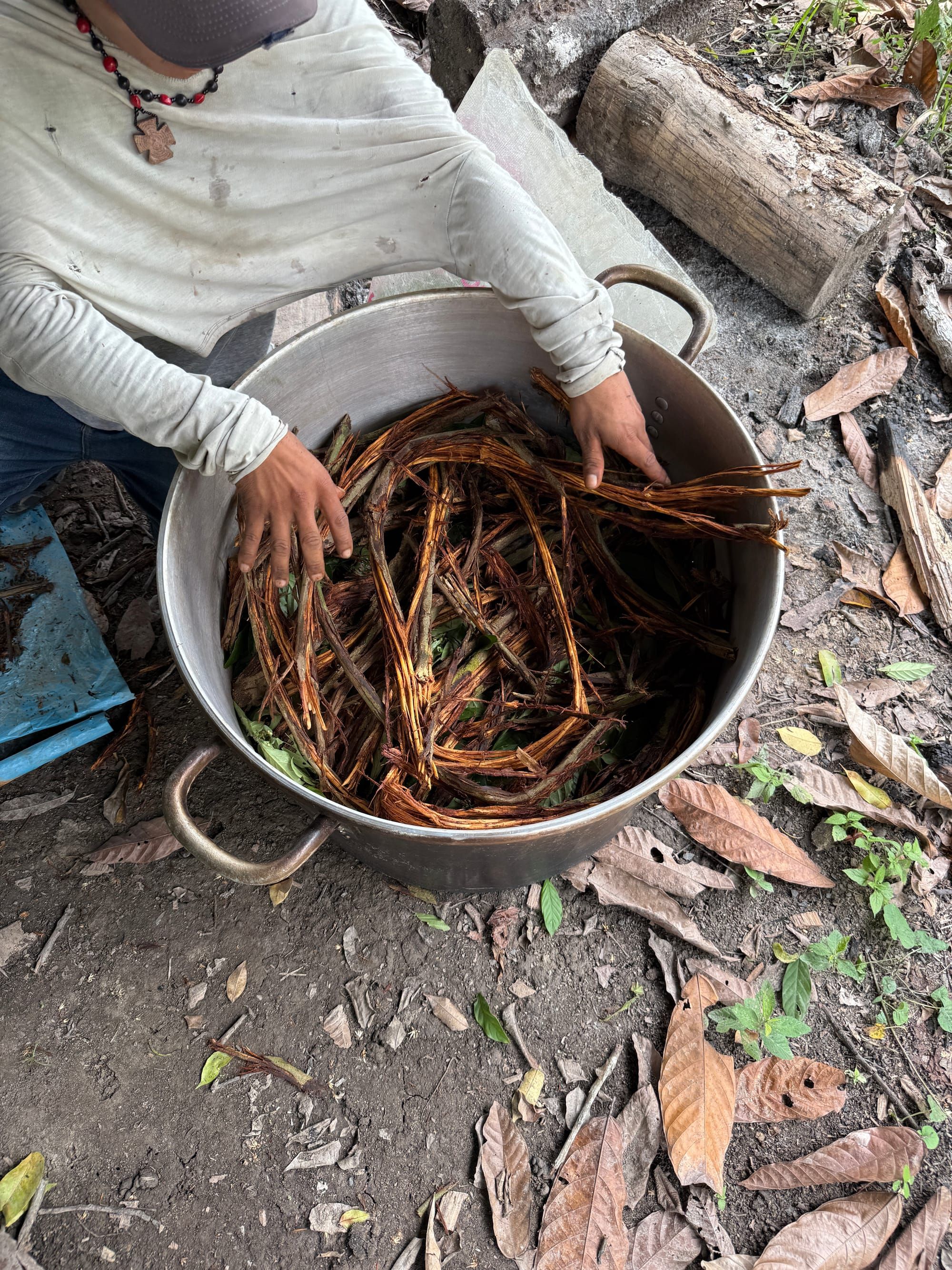
Ayahuasca — "the brew" — is the sacred Amazonian medicine made by long-cooking the Banisteriopsis caapi vine with a DMT-bearing leaf (usually chacruna). The vine's MAO-inhibiting β-carbolines make the leaf's DMT orally active — a pharmacological synergy Amazonian peoples mastered long before Western science could explain it (McKenna et al., 1998; Riba, 2003). Drunk ceremonially under a maestro's icaros, it brings visions, emotional release and the purge (la purga). New to all this? Start with What is Ayahuasca? — this page looks closer at the medicine itself.
| Detail | Information |
|---|---|
| What it is | The ceremonial Amazonian brew (Quechua aya "soul/spirit" + huasca "vine") |
| Core ingredients | Banisteriopsis caapi (vine, MAOIs) + chacruna / chaliponga (DMT leaf) |
| Active synergy | β-carbolines (harmine, harmaline, THH) inhibit MAO → the leaf's DMT becomes orally active |
| Onset / duration | Effects begin ~30–60 min; last ~4–6 hours |
| The purge | La purga — emetic/purgative, treated as integral to the healing, not a side-effect |
| Main tradition | Shipibo-Konibo (Ucayali, Peru) and pan-Amazonian |
| Key risk | MAOI × SSRI/SNRI → serotonin syndrome; cardiac & psychiatric cautions (see Safety) |
Ayahuasca is a psychoactive brew from the indigenous traditions of the Amazon basin. The word comes from the Quechua aya (soul, spirit, or the dead) and huasca (vine or cord) — the vine of the soul.
What the Brew Is
Ayahuasca is made by combining two key ingredients:
- Banisteriopsis caapi — a woody liana (the ayahuasca vine itself) containing β-carboline alkaloids: harmine, harmaline and tetrahydroharmine (THH). These act as monoamine oxidase inhibitors (MAOIs), essential to making the brew orally active (Rivier & Lindgren, 1972; McKenna et al., 1998).
- Psychotria viridis (Chacruna) or Diplopterys cabrerana (Chaliponga) — leaves containing N,N-dimethyltryptamine (DMT). DMT is normally broken down in the gut by monoamine oxidase; the MAOIs in the vine prevent this, allowing DMT to reach the brain (McKenna et al., 1998; Riba, 2003).
This pharmacological synergy — recognised by Amazonian peoples centuries before Western science understood enzyme inhibition — is one of the marvels of ethnobotany: a precise two-plant combination identified within an extraordinarily diverse rainforest flora (McKenna et al., 1998). The actual concentrations of these alkaloids vary considerably from brew to brew, depending on the plants used, their proportions and the long cooking process (Kaasik et al., 2021).
The Tradition
Ayahuasca has been used ceremonially across the Amazon for centuries. Its use spans many peoples across Peru, Ecuador, Colombia and Brazil, and is especially well documented among the Shipibo-Konibo of the Ucayali River region in Peru (Jauregui et al., 2011; González et al., 2021).
In the Shipibo tradition, ayahuasca is treated as a sacrament, a diagnostic tool, and a means of communication with the spirit world — not a recreational substance. Ceremonies are led by a curandero or maestro/maestra trained through years of plant dietas, who sings icaros — sacred songs understood to direct and shape the medicine's effects (Jauregui et al., 2011). Ceremonies typically take place at night, in darkness; effects begin within 30–60 minutes and last around 4–6 hours (Riba, 2003).
The Experience
No two ceremonies are alike; the experience is highly personal and can range from blissful and visionary to challenging and frightening. Commonly reported elements include:
- Visions: complex, often geometric or narrative visual experiences, sometimes including encounters with entities or symbolic imagery.
- Emotional processing: buried memories, grief and unresolved emotion often surface — considered central to the healing.
- Physical purging: vomiting (la purga) is common. Far from a mere side-effect, the tradition — and a growing body of scholarship — treats purging as integral to the medicine's cleansing action, physical, emotional and energetic (Politi et al., 2021; Fotiou & Gearin, 2019).
- Insight and clarity: many participants report clear understanding of personal patterns, relationships and direction.
- Challenging experiences: fear, confusion and psychological distress can arise, and are often the most significant part of the work even when uncomfortable.
The Vine Itself
While DMT provides the visionary component, many traditions hold the vine — Banisteriopsis caapi — to be the true teacher and the source of the brew's intelligence. In these traditions the word ayahuasca refers to the vine itself; the admixture plants (chacruna, chaliponga) are "helpers" or light-bringers, but the healing and the direction come from the vine. This is why the brew is named for the vine, not the DMT — and why understanding ayahuasca as merely "a way to take DMT orally" misses the point.
Safety
Ayahuasca's intrinsic physiological toxicity is low, but it carries real, specific risks (Gable, 2007; ICEERS, 2021):
- SSRIs / SNRIs and other serotonergic drugs: combined with the vine's MAOIs these can cause serotonin syndrome, which can be life-threatening; a medically guided washout is essential (Callaway & Grob, 1998).
- Heart conditions: ayahuasca transiently raises heart rate and blood pressure (Riba, 2003; Gable, 2007).
- Psychiatric conditions: people with schizophrenia, psychosis or bipolar disorder may be at heightened risk (dos Santos et al., 2017).
- Unvetted retreats & admixtures: facilitator quality varies, and brews are sometimes adulterated with genuinely dangerous additives such as toé (Brugmansia) — research thoroughly.
For the full picture, see our Safety & Harm Reduction page.
Common Questions
What is ayahuasca made of?
Two plants: the Banisteriopsis caapi vine, which supplies MAO-inhibiting β-carbolines (harmine, harmaline, THH), and a DMT-containing leaf — usually chacruna (Psychotria viridis) or chaliponga (Diplopterys cabrerana) (McKenna et al., 1998).
Why does ayahuasca need two plants?
DMT taken by mouth is normally destroyed in the gut by the enzyme monoamine oxidase. The vine's β-carbolines inhibit that enzyme, letting the leaf's DMT pass into the bloodstream and reach the brain — which is why the two are brewed together (McKenna et al., 1998; Riba, 2003).
Why do people purge (vomit) on ayahuasca?
Purging — la purga — is common, and is regarded within the tradition (and increasingly in scholarship) as integral to the medicine's cleansing action rather than a mere side-effect (Politi et al., 2021; Fotiou & Gearin, 2019).
Is ayahuasca safe?
Its intrinsic physiological toxicity is low, but it carries real risks: combined with SSRIs/SNRIs it can cause serotonin syndrome, and it is contraindicated in serious heart and psychiatric conditions (Callaway & Grob, 1998; Gable, 2007; dos Santos et al., 2017). See our Safety & Harm Reduction page.
Is ayahuasca legal?
It varies by country. DMT is internationally controlled, so ayahuasca is restricted in many jurisdictions, though some countries grant religious or traditional-use exemptions. Always check local law before engaging.
References
- Callaway, J.C. & Grob, C.S. (1998) 'Ayahuasca preparations and serotonin reuptake inhibitors: a potential combination for severe adverse interactions.' Journal of Psychoactive Drugs 30(4): 367–369. doi:10.1080/02791072.1998.10399712
- Fotiou, E. & Gearin, A.K. (2019) 'Purging and the body in the therapeutic use of ayahuasca.' Social Science & Medicine 239: 112532. doi:10.1016/j.socscimed.2019.112532
- Gable, R.S. (2007) 'Risk assessment of ritual use of oral dimethyltryptamine (DMT) and harmala alkaloids.' Addiction 102(1): 24–34. doi:10.1111/j.1360-0443.2006.01652.x
- González, D., Cantillo, J., Pérez, I., Carvalho, M., Aronovich, A., Farré, M., Feilding, A., Obiols, J.E. & Bouso, J.C. (2021) 'The Shipibo ceremonial use of ayahuasca to promote well-being: an observational study.' Frontiers in Pharmacology 12: 623923. doi:10.3389/fphar.2021.623923
- ICEERS (2021) Ayahuasca Technical Report. International Center for Ethnobotanical Education, Research & Service. ICEERS report
- Jauregui, X., Clavo, Z.M., Jovel, E.M. & Pardo-de-Santayana, M. (2011) '"Plantas con madre": plants that teach and guide in the shamanic initiation process in the East-Central Peruvian Amazon.' Journal of Ethnopharmacology 134(3): 739–752. doi:10.1016/j.jep.2011.01.042
- Kaasik, H., Souza, R.C.Z., Zandonadi, F.S., Tófoli, L.F. & Sussulini, A. (2021) 'Chemical composition of traditional and analog ayahuasca.' Journal of Psychoactive Drugs 53(1): 65–75. doi:10.1080/02791072.2020.1815911
- McKenna, D.J., Callaway, J.C. & Grob, C.S. (1998) 'The scientific investigation of ayahuasca: a review of past and current research.' The Heffter Review of Psychedelic Research 1: 65–77.
- Politi, M., Tresca, G., Menghini, L. & Ferrante, C. (2021) 'Beyond the psychoactive effects of ayahuasca: cultural and pharmacological relevance of its emetic and purging properties.' Planta Medica 88(14): 1275–1286. doi:10.1055/a-1675-3840
- Riba, J. (2003) Human pharmacology of ayahuasca (doctoral thesis). Universitat Autònoma de Barcelona. Full text (TDX)
- Rivier, L. & Lindgren, J.-E. (1972) '"Ayahuasca," the South American hallucinogenic drink: an ethnobotanical and chemical investigation.' Economic Botany 26(2): 101–129. doi:10.1007/BF02860772
- dos Santos, R.G., Bouso, J.C. & Hallak, J.E.C. (2017) 'Ayahuasca, dimethyltryptamine, and psychosis: a systematic review of human studies.' Therapeutic Advances in Psychopharmacology 7(4): 141–157. doi:10.1177/2045125316689030